ANATOMY OF SUGAR GLIDER


PATAGIUM
Sugar gliders glide by catching air with their patagium, or gliding membrane, which stretches from wrist to ankle and retracts when not in use. Gliders have some control over their patagium, and mine love to stretch it out during a hanging yawn. Avoid harnesses or anything that restricts this delicate membrane.
Sugar gliders glide by catching air with their patagium, or gliding membrane, which stretches from wrist to ankle and retracts when not in use. Gliders have some control over their patagium, and mine love to stretch it out during a hanging yawn. Avoid harnesses or anything that restricts this delicate membrane.

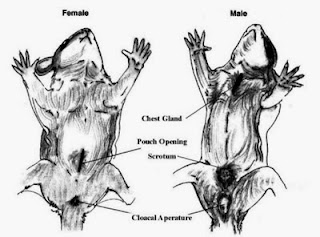
CLOACA
Like birds and reptiles, sugar
gliders have a combined urogenital tract called a cloaca. They urinate,
defecate, copulate and give birth from the same opening. As a glider walks,
they slightly extend the cloaca to deposit drops of urine behind them, leaving
a trail of scent. Since both sexes have a cloaca, new owners are often confused
on how to Sex a joey, mistaking the cloaca for the penis.
Female sugar
gliders have two uteri and two vaginas, and they usually have two joeys at a
time, one from each uterus. Joeys are only inside the uteri for 16 days and are
about the size of a rice grain before they are birthed from the cloaca. These tiny,
undeveloped babies climb along a saliva trail that mom licks between her cloaca
and her pouch, where they latch their jaws around one of moms four teats and
stay put for another two to three months (about 74 days) to finish development.

TAIL
Sugar gliders have long tails that
they can use like a rudder to help stabilize and steer a long glide. Some
gliders are "tail carriers" that like to wrap their tails around
objects and drag them around, however their tails are not quite prehensile. Gliders
do have some muscle control, but it is not strong enough to hold their weight,
nor finely controlled enough for grasping. A glider's tail posture is a tell
for its mood. When the tail is in a small arch, poop is on the way. I've
noticed when my joeys feel less secure, just pulled out of a pouch or taken
into an unfamiliar room, their tails will curl up into a tight spiral against
them. A nervous, defensive glider who is investigating a possible threat will
often "snake tail" - their tail stands up in an undulating S.

SCENT
Gliders have three scent glands: on
top of their head, on their chest, and next to their cloaca. The head gland is
only active in an intact male, who will lose fur in a diamond shape on his
forehead, and secrete an oily scenting substance that can stain the surrounding
fur yellow, orange, or brown. Neutering a male will prevent the bald spot from
developing, or cause the fur to grow back if the male was already mature.
Females do not develop a bald spot. Males often rub their head gland onto a
cage mate or joey's chest gland to mark them as colony members. Intact males will also secrete scent from
their chest glands, coloring their underbelly. My breeding leucitic male has a
burnt orange chest gland for several weeks around the time new joeys come out
of pouch. Both sexes will grab an
object or partner with their front paws, and rub their chest on it to mark.
Feel honored if a glider rubs his or her chest on you this way, they are claiming
you as their very own. The gland near
their cloaca can spray a small burst of skunk-like scent in both sexes. It is
not very strong and dissipates quickly, but indicates the glider is terrified
and needs some time in a safe, dark place to calm down.
FEET
Sugar gliders' front feet are agile hands that grasp and hold objects. Their four toes and thumb are each tipped in a curved nail. Their hind feet have two outer toes with curved claws, two smaller inner toes with grooming nails, and a wide thumb without a nail. They are able to stand up on their hind feet, like a prairie dog, and are able to hang from a single foot comfortably.
Sugar gliders' front feet are agile hands that grasp and hold objects. Their four toes and thumb are each tipped in a curved nail. Their hind feet have two outer toes with curved claws, two smaller inner toes with grooming nails, and a wide thumb without a nail. They are able to stand up on their hind feet, like a prairie dog, and are able to hang from a single foot comfortably.

EYES
Sugar gliders have very large eyes adapted to low light vision. Sugar gliders have both cones and rods in their eyes. Rods are cells adapted to dim light, while cones are bright light adapted, color sensitive cells. Sugar glider cones function like those in birds and reptiles. They have single and double cone cells which contain oil droplets. In other species with this style of cone cell, the droplets contain pigments that filter the wavelength of light and provide for color vision. In sugar gliders, the oil droplets lack pigment, which is consistent with other nocturnal species, and reasonable because they need adequate light getting through to their retina more than they need color vision.
Sugar gliders have very large eyes adapted to low light vision. Sugar gliders have both cones and rods in their eyes. Rods are cells adapted to dim light, while cones are bright light adapted, color sensitive cells. Sugar glider cones function like those in birds and reptiles. They have single and double cone cells which contain oil droplets. In other species with this style of cone cell, the droplets contain pigments that filter the wavelength of light and provide for color vision. In sugar gliders, the oil droplets lack pigment, which is consistent with other nocturnal species, and reasonable because they need adequate light getting through to their retina more than they need color vision.

Comments
Post a Comment